Elements of Art Color Wheel Worksheet Elements of Art Color Wheel Worksheet Colored
Introduction
Color and color theory form the foundation of art besides as design. Gifted children are often tuned in to the aesthetic nature of things at an early age and can appreciate the nuances of color, likewise as the way colors are blended, tinted and shaded.
Guiding Questions
What is color? How do we correspond and create color?
Learning Objectives
Subsequently completing this project, students will be able to:
- Identify color terms using the academic vocabulary of the discipline
- Evaluate the use of color in art painting
- Create a contrary color scheme of a painting
- Design an "eye spy" action for a painting, focused on the use of color
- Conduct independent research on color and analyze that research
Lesson 1: Introduction to color
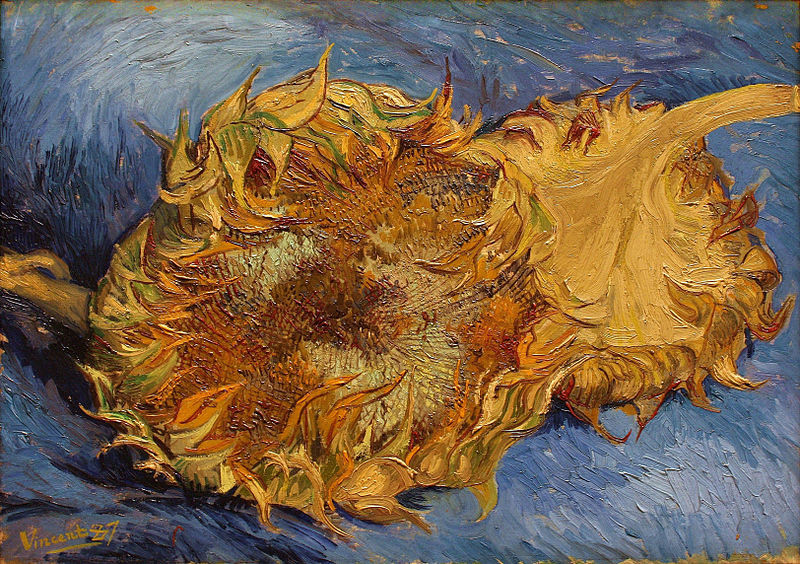
Look at this picture. What colors do you see? List the three colors you recall are nigh hands visible in this painting.
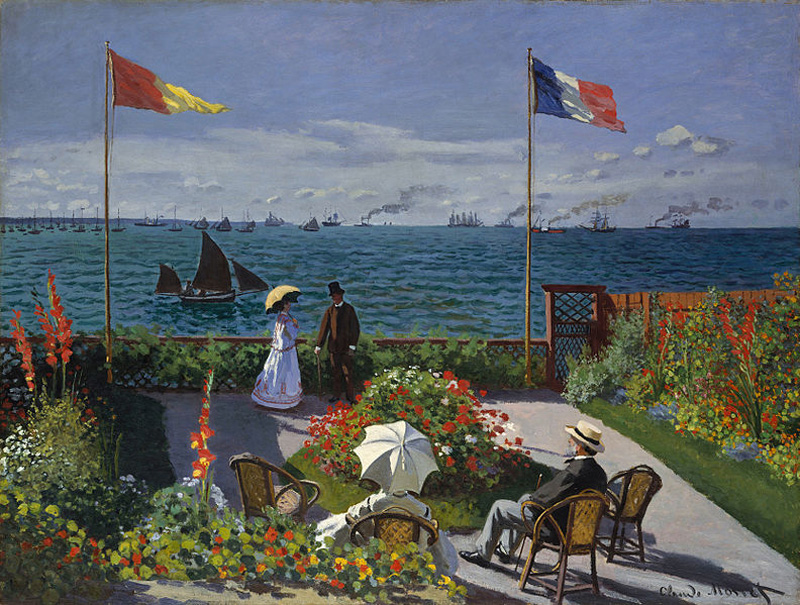
How well-nigh this one? What colors do you see here? Listing the three colors y'all retrieve the artist used almost in this painting.
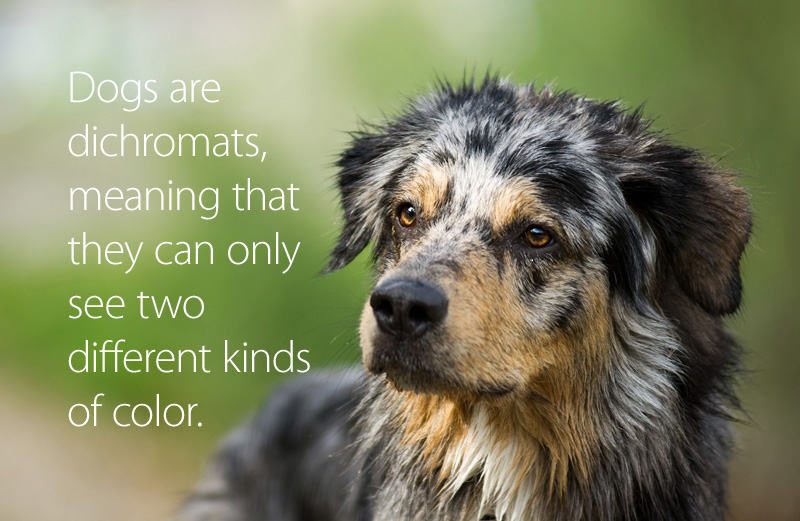
Three things to know virtually Color:
- Color is a way that we draw an object based on the way that it reflects or emits calorie-free.
- Your eye can see different colors because a part of your heart called the retina is sensitive to dissimilar wavelengths of light.
- Humans are what is called "trichromats," meaning our retinas take iii different kinds of cells that tin can receive color. Those cells are chosen cones.
What is your favorite color? What do you lot recall the most mutual favorite color in the globe is? (Scroll downwardly further to notice the answer.)
To organize colors and show their relationship to each other, nosotros use a color cycle. This shows the colors and how they are related to each other.
On a traditional color wheel, three colors are chosen master colors. From these 3 colors, all of the colors on the color wheel can be made. The three main colors on the traditional color wheel are red, yellow and blue. Can you find the primary colors on this color wheel? (Bluish is the nearly popular color in the world.)
Lesson two: The language of color
Like many disciplines, color has its own vocabulary. Spotter the video below for an introduction to the linguistic communication of colour. Next, take the pre-assessment to see how much yous already know about color's words.
Color Vocabulary Pre-Assessment
The nautical chart that shows the human relationship of different colors to each other is called the (1) _______________________. Instead of the give-and-take "color," one could also utilise the three-letter word (2) ________.
The three colors from which all other colors are made are called (three)________________ colors, and they are (four)__________, ____________, and ____________. Colors that are created by mixing equal parts of the colors to a higher place are chosen (5) _____________________ colors, and they are (vi) _______________, _______________, and ____________________. Colors that are created from equal parts of each of the two kinds of colors above are chosen intermediate or (7)________________________ colors. When describing these colors, place the (8) ________________ color starting time.
Colors that are side by side to each other on the color wheel are called (9)___________________. Colors that are opposite to each other on the color bicycle are called x)_______________. When these colors are placed next to each other, they make each other seem (11) ____________________. When mixed equally, they create muddy tones similar black, gray, and dark-brown.
If you lot add white to a color, that is called a (12) ______________. If you add together black to a colour, that is called (thirteen)_________________.
If something only uses one color, information technology is called (14)______________________________.
If something uses more than one color, it is called (15) _________________________.
If something is completely lacking in color, it is called (sixteen)_______________________.
The colors on the green/blue/violet side of the colour wheel are chosen (17) ___________. The colors on the carmine/orange/yellow side of the color wheel are called (xviii) __________.
When completed, check your answers. If you lot got at least 14 of the 18 correct, motion on to Lesson iii below. If you didn't, read more about bones color theory earlier you movement on.
Lesson 3: Finding the colors
In the pictures below, you lot will find examples of many of the colors on the color cycle. Answer the questions that go with each pic.
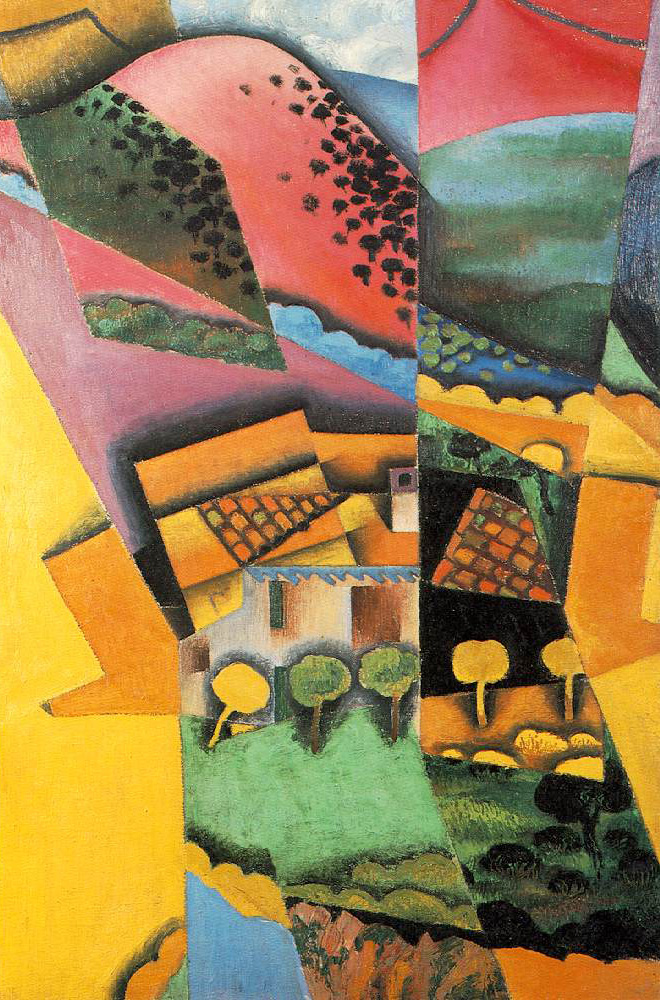
This painting, called Landscape at Ceret, was painted by the Spanish creative person Juan Gris.
In the painting, place six places where you see the three primary colors. Then, place two places where you see two primary colors next to each other. Identify a checkmark on 2 places you lot come across a primary color adjacent to a secondary color. Circle a place you lot run into a shade of blue. Circumvolve a place you see a tint of green.
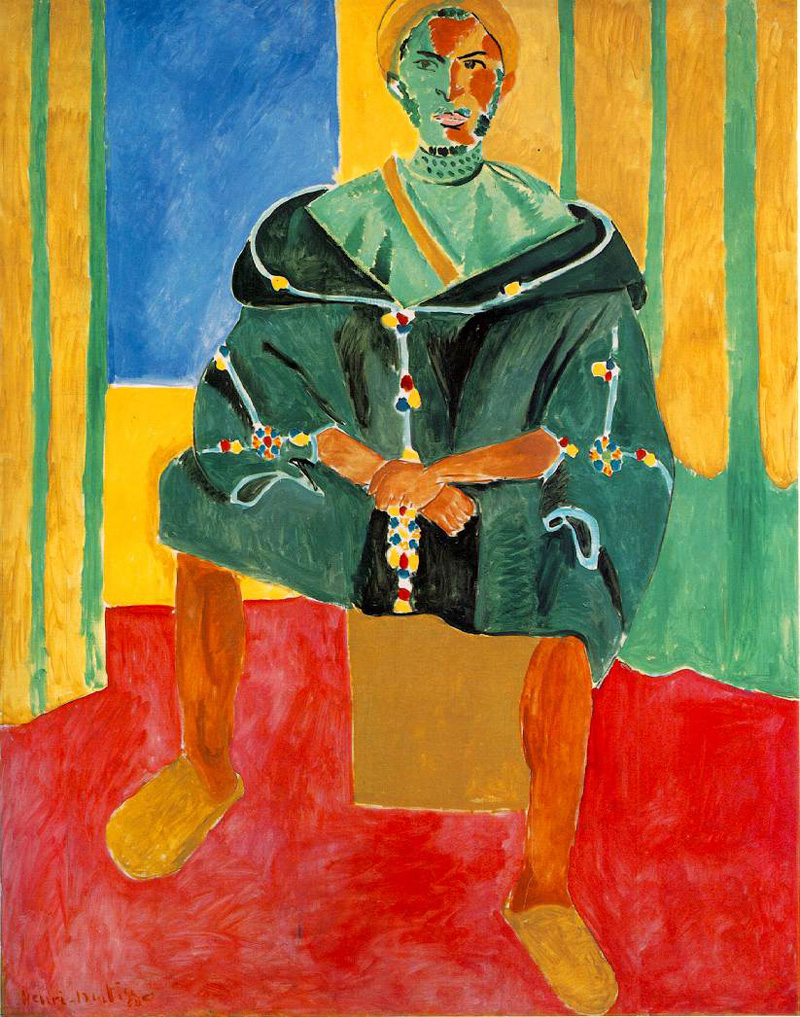
This painting, Le Rifain assis, was painted by the French creative person Henri Matisse.
This painting has a very narrow color palette. List the colors you run into in the painting and identify them as main (p) or secondary (s) or neither (n).
Below, y'all volition observe this same painting in blackness and white. Using colored pencils, crayons, or fine tip markers, color in the painting. Instead of reproducing the colors the fashion you see them in the painting on the previous folio, select a complementary color (retrieve that those are contrary each other on the colour bike). For instance, where y'all come across green, color a corresponding shade or tint of cerise, and where you lot see blue, color in orange. Use Adobe's color wheel to find the complementary color — just spin the bike until you run into the color you are looking for, and its complement will exist on the other side.
What did you notice in doing this practice virtually how the feeling of the painting changed? Is the painting happier? More deplorable? Darker? Lighter?
.jpg)
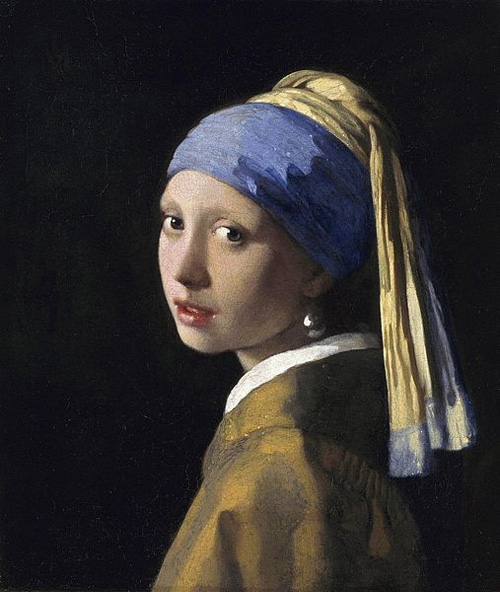
In this painting by Johannes Vermeer chosen Daughter with a Pearl Earring, the colour palette is very limited, yet in an entirely different style from the Matisse painting shown earlier.
Originally, the nighttime background had a green coat over it, simply this is no longer visible. Imagine what the colour green would accept looked like side by side to the colors yous can meet now. Where practise you think information technology would have made more difference, in the skin or the wear?
Art historians have institute that Vermeer used 11 pigment colors in this painting:
- white lead
- chocolate-brown ochre (raw umber)
- xanthous ochre
- charcoal blackness
- bone black
- vermilion (a red with an orangish undertone)
- ultramarine (lapis lazuli)
- red madder
- indigo (deep, clear blue)
- red ochre
- weld (yellowish)
This painting shows how complex color tin can get. Painters practise not simply load their brushes with a color and add together it to the canvas; they mix the colors on a palette first. Additionally, some of the colors Vermeer used are no longer visible. This tin can go far difficult to detect the colors in the painting, but you may be able to meet some of them. Knowing these things, what colors from the pigments listed in a higher place practice you think you can observe? It may help to to take a closer look at the painting.
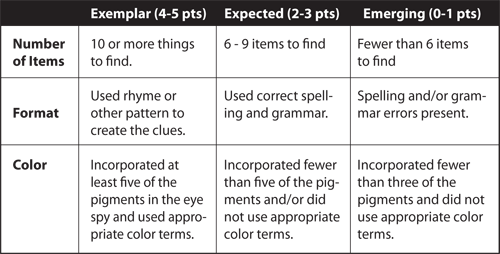
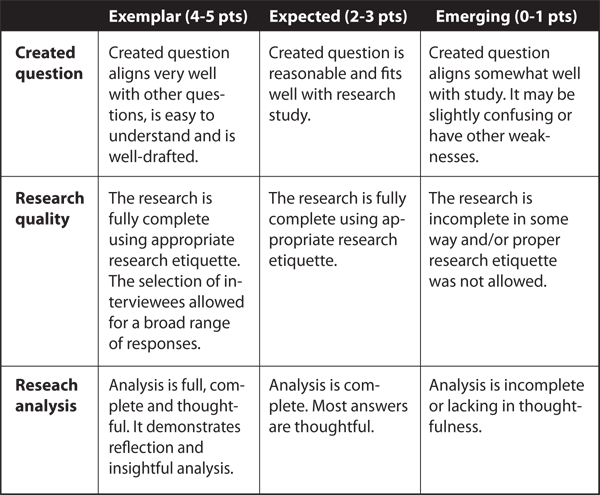
Although the painting looks simple, upon close examination, it is a complex blend of colors. Create an "middle spy" activity for the painting, using this rubric. You may look at the National Book Fesitival for an idea (look at the verse form at the bottom for an example of a rhyming, poetic class).
Lesson 4: Color research
Conduct a small-scale inquiry written report on people'southward favorite colors. With help from your teacher or parents, identify four people you lot tin interview. You volition ask the questions below, and one more than that you create (add together that to the terminal, bare line).
Good inquiry etiquette is that you volition not interrupt, not share your own opinion to agree or disagree with the responses, and thank the person sincerely for his/her time.
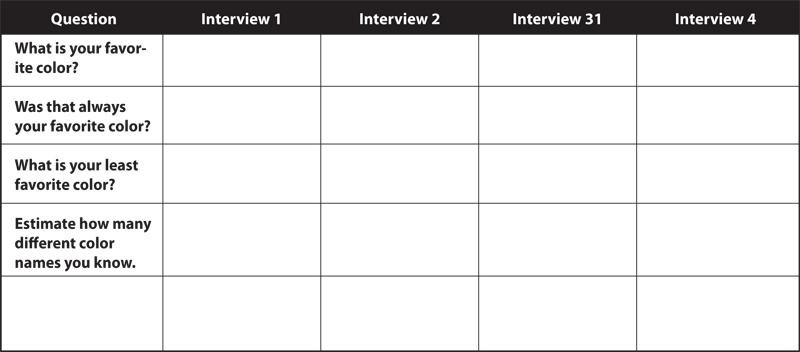
Analyze your data. Did any patterns emerge of favorite or to the lowest degree favorite colors? Were the favorite colors of the people you lot interviewed stable or had they changed?
Add up the total number of the estimated color names and divide by four to detect the boilerplate number of colors your interviewees think they tin can proper name. How many of the favorite colors were primary colors?
How did your findings compare with what nosotros know near the most popular color in the earth? How many were secondary colors? What in your findings surprised you? What did you discover in the responses to the question you created? Let this rubric guide you.
Assessment
Lesson ane:
- Sunflower film: Reasonable responses include blueish, yellow, greenish, brown, and beige.
- Oceanscape: Reasonable responses include any combination of red, blue, white, or dark-green.
Lesson 2: Color Vocabulary Pre-Cess Central:
- color wheel
- hue
- primary
- blood-red, yellow, blueish (no social club necessary)
- secondary
- greenish, orange, violet (no order necessary)
- tertiary
- principal
- analogous
- complementary
- brighter
- tint
- shade
- monochromatic
- polychromatic
- achromatic
- cool
- warm
Lesson three: The initial activities in this lesson are subjective, to a great extent. If you desire to assess, look for full and reasonable responses. The rubric for the Eye Spy activity is included in the section.
Lesson iv: The rubric for the independent research is included in the section.
Extension
Read It!
Young Readers:
- The Colour Kittens by Margaret Wise Brown
- Celebrity Cat: With Paintings from Art Galleries Around the World by Meredith Hooper
- Mouse Paint past Ellen Stoll Walsh
- Museum Trip past Barbara Lehman
- Color Dance by Ann Jonas
- White Rabbit's Color Book past Alan Bakery
Older Readers:
- Color Theory: An Essential Guide to Colourpast Patti Mollica
- Pantone: The Twentieth Century in Color by Leatrice Eiseman
Surf Information technology!
- Practice mixing colors on your figurer (UK just)
- Make a rainbow of color with milk
- Examination your colour vision
- Read about the history of the color wheel
- Read virtually people who see colors differently
- Learn more about Vermeer and Girl with a Pearl Earring at:
- essential vermeer 2.0
- Mauritshuis.nl
- girl-with-a-pearl-earring.info/
0 Response to "Elements of Art Color Wheel Worksheet Elements of Art Color Wheel Worksheet Colored"
Post a Comment